
Governed Stablecoin Payouts: A Technical Reference
Architect USDC and USDT payouts: payment intents, policy gates, approvals, counterparty screening, flexible signing, settlement tracking, and audit evidence.
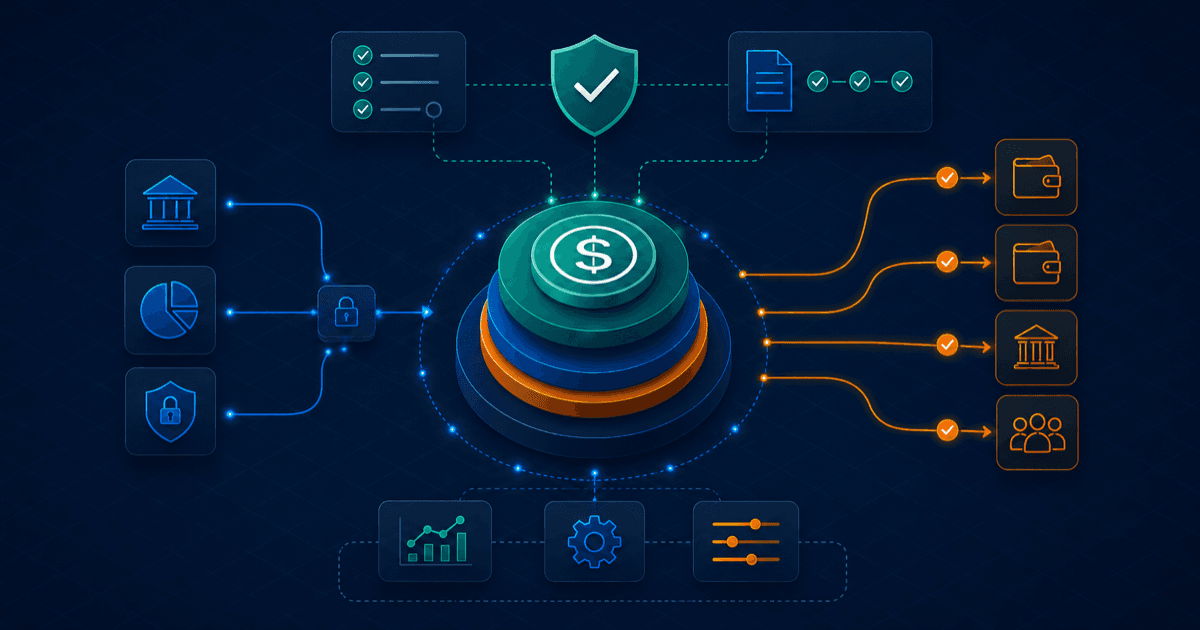
- A production payout runs nine stages — intent, balance, fee, policy, screening, approvals, signing, broadcast, and audit evidence — not a single signature.
- Policy gates, counterparty screening, and multi-party approvals all run server-side before anything is signed: governance is enforced by the infrastructure, not the client.
- The same governed pipeline is exposed over both REST and MCP, so human dashboards and AI agents hit identical policy and audit paths.
Stablecoin payouts look simple from the outside: pick a recipient, sign a USDC transfer, broadcast it. They are not simple. A production payout layer resolves payment intent, checks balances and fees, applies policy, screens counterparties, routes approvals, selects the right signer, tracks settlement, and emits audit evidence.
This matters at scale. Stablecoin transaction volume reached a record $33 trillion in 2025 (+72% YoY), with USDC and USDT together processing more than 95% of that volume (Bloomberg, citing Artemis Analytics). Stablecoin payment volume specifically hit roughly $390 billion annualized by the end of 2025, with B2B payments accounting for ~$226 billion — about 60% of the total (Artemis Analytics). The payments infrastructure underneath has to keep up.
This is a developer-facing reference for teams building or evaluating governed stablecoin payout infrastructure. If finance, compliance, or your CFO is asking “where do USDC and USDT actually go after we click send?” this is the architecture behind the answer.
The nine stages of a governed payout
intent → balance check → fee estimation → policy gate → counterparty screening
→ approvals → signing → broadcast / settlement → evidence| # | Stage | What it answers | Failure mode |
|---|---|---|---|
| 1 | Intent | What does the payer want to do? | Invalid recipient, unsupported asset |
| 2 | Balance | Does the source wallet have funds? | Insufficient balance, unconfirmed inflow |
| 3 | Fee estimation | How much will the chain charge? | Fee spike, gas-token shortage |
| 4 | Policy gate | Is this transfer allowed? | Off-allowlist, over cap, outside window |
| 5 | Counterparty screening | Is the recipient safe to send to? | Sanctions match, scam flag, threat-intel hit |
| 6 | Approvals | Who needs to authorize this? | Insufficient approvers, approval expired |
| 7 | Signing | Who or what produces the signature? | MPC quorum unreachable, HSM unavailable |
| 8 | Broadcast / settlement | Did the chain accept and finalize it? | Reorg, nonce collision, dropped transaction |
| 9 | Evidence | Was the full decision path recorded? | Audit-chain integrity break |
Each stage should produce a structured state and failure type. The calling system should know whether to retry, escalate, request approval, update gas funding, block the transfer, or surface the issue to an operator. That is what separates payout infrastructure from a transfer script.
Stage 1 — Intent: speak in payments, not transactions
The single biggest mistake teams make when wiring up stablecoin payouts is leaking chain-level details into the calling system.
A payment is not a transaction.
A transfer of “1,000 USDC to vendor X by Friday” is the payment intent. The exact token contract, chain ID, gas token, nonce, signer, and calldata are execution details the payout layer should resolve.
Correct intent shape:
{
  "tenant_id": "acme-payroll",
  "payment_id": "INV-2026-04-184",
  "asset": "USDC",
  "amount": "1000.00",
  "recipient": "0xa5e2…7c91",
  "recipient_chain_hint": "ethereum",
  "metadata": {
    "vendor": "Lighthouse Studios",
    "memo": "April retainer"
  },
  "deadline": "2026-05-08T17:00:00Z"
}
Notice what is not in the intent:
contract address
gas price
nonce
signer ID
network-specific transaction encoding
Those belong to the payout layer. See the token resolution glossary entry for how a label like USDC becomes a verified contract address per chain.
This separation lets a single accounting, payroll, or treasury system route payouts across many chains without chain-specific code.
Stages 2 and 3 — Balance and fee: the boring stages that fail in production
Balance and fee estimation look mechanical until you ship them at volume.
Balance gotchas
Unconfirmed inflows. A treasury wallet just received 50,000 USDC on Base 12 seconds ago. Is it spendable? That depends on confirmation policy. A balance check that ignores confirmation depth will eventually fail during congestion, reorgs, or delayed settlement.
Multi-rail balances.“Do we have 100K USDC?” may mean across Ethereum, Polygon, Arbitrum, Base, Tron, and Solana. The payout layer should resolve where funds exist, which rail the recipient expects, and what execution path is allowed by policy.
Gas-token shortage. A wallet can hold 100K USDC and still fail to send if it lacks the native gas token. The system should either prepare a gas-funding action under policy or return a structured gas_token_shortage error with the chain and shortfall amount.
Fee estimation
Fees are not static. A fee estimate captured at intent creation may be stale by the time approvals complete.
Best practice:
estimate at intent creation
re-estimate before signing
abort or escalate if the new estimate exceeds policy thresholds
record both estimates in evidence
The threshold should be a policy parameter, not a hard-coded constant. WalletSuite's Evidence API records fee decisions so auditors can verify why a payout proceeded or escalated.
Stage 4 — The policy gate
The policy gate is the load-bearing component of a governed payout layer.
A policy gate evaluates rules before any signature is produced.
| Rule class | Examples |
|---|---|
| Identity & allowlist | Recipient must be approved; agent token must be bound to this wallet |
| Amount & velocity | Single-transfer cap; daily cap; weekly velocity limit |
| Time & window | Business-hours only; not during lock windows; not after policy expiry |
| Asset & chain | Stablecoin-only; approved chains only; approved token contracts only |
| Workflow composition | Transfer-only; no arbitrary contract calls; calldata pattern restrictions |
A policy hit should return a structured decision, not a generic “blocked.”
Example:
{
  "decision": "requires_review",
  "matched_rule": "vendor_payout_over_10000",
  "required_approver_role": "finance_admin",
  "reason": "USDC payout exceeds tenant single-transfer limit"
}
That decision becomes part of the audit record.
Per-tenant policies
A B2B platform serving many customers must run distinct policy sets per tenant. Vendor allowlists, spend caps, approver roles, chain preferences, and review windows all differ per customer.
WalletSuite's tenant governance model makes tenant_id part of every policy evaluation. Cross-tenant rule bleed should be impossible by architecture, not avoided by discipline.
External policy hooks
Sometimes a rule lives in the customer's own system: “block if our internal compliance service returns red.” A well-designed payout layer supports external policy hooks with clear timeout behavior.
The safe default is:
policy hook unavailable → controlled degradation or deny, depending on tenant policy
policy hook returns red → no signing
policy hook returns review → approval required
Stage 5 — Counterparty screening
Counterparty screening is one of the stages that separates governed payouts from raw transfers.
It should run after balance and fee checks and before signing. The output should be discrete signals and policy actions, not a vague score.
Included screening signals
| Signal | What it evaluates |
|---|---|
| Sanctions | OFAC SDN, UN, EU, and UK FCDO list matches |
| Scam history | Public scam, phishing, drainer, and rug-pull indicators |
| Threat intel | Exploit, suspicious approval, malware, and incident signals from public threat feeds |
| Behavioral flags | Wallet age, concentration, transfer patterns, and other live behavioral observations |
Sanctions matches can hard-block signing. Other signals can route the payout to review, denial, or advisory handling based on tenant policy.
Sanctions screening is not a static problem. As of February 2025, the OFAC SDN list contained 1,245 unique cryptocurrency wallet addresses, up roughly 32% year-over-year, with new designations added regularly. A production payout layer must refresh its sanctions feeds on a defined cadence and treat the result as a rolling control, not a one-time check.
Enterprise attribution signals
Some signals require licensed attribution data.
| Signal | What it evaluates |
|---|---|
| Mixer exposure | Attribution-partner data for mixer or tumbler exposure |
| Stolen-fund attribution | Attribution-partner data for hack proceeds and theft clusters |
| Darknet links | Attribution-partner data for darknet-market associations |
These should be labeled separately from included screening. They are valuable, but they depend on attribution partners and commercial coverage.
Screening output
A screening decision should be structured and reproducible.
{
  "counterparty": {
    "address": "0xa5e2…7c91",
    "chain": "ethereum",
    "signals_evaluated": [
      "sanctions",
      "scam_history",
      "threat_intel",
      "behavioral"
    ],
    "verdict": "review",
    "flags": [
      {
        "signal": "behavioral",
        "code": "new_counterparty_high_value",
        "severity": "medium"
      }
    ],
    "policy_action": "requires_approval",
    "source_versions": {
      "sanctions": "2026-05-06",
      "scam_history": "2026-05-06T12:00:00Z",
      "threat_intel": "2026-05-06T12:10:00Z",
      "behavioral": "wrr-v1"
    }
  }
}
Do not collapse this into a single calibrated number unless you have labeled outcomes, model governance, and a defensible validation process. Discrete signals are easier to explain, route, audit, and reproduce.
Stage 6 — Approvals: humans, machines, and the line between
Stablecoin payouts often require a human in the loop, and the audit trail must prove it.
Three approval models are common.
1. Threshold approval
N-of-M humans must authorize a payout.
Example:
Vendor payout above $10,000 → 2-of-3 Finance approvers requiredEach approver uses an authenticated approval flow. The payout state machine waits until quorum is met or the approval window expires.
2. Role-based approval
The approver must hold a specific role.
Example:
Cross-border payout → Compliance approval required
High-value payout → Treasurer approval required
New counterparty → Ops + Compliance approval required
Roles should bind to enterprise IAM through SAML/OIDC. The payout layer should not hold passwords.
3. Pre-approved policy windows
For streaming payouts where per-transfer approval does not scale, a team can pre-approve a policy window.
Example:
Allow up to $50,000/day to allowlisted creators on Base.
Anything outside the window requires review.
The FAQ includes worked examples of each model.
Replay protection
An approval must bind to:
payment_id
policy version hash
amount
asset
recipient
approval nonce
An attacker who captures a previous approval should not be able to replay it against a new payment, even if the details look similar.
Stage 7 — Signing: pick the right backend per workflow
This is where flexible signing becomes operationally important.
The same payout intent can route through different signing paths depending on workflow constraints.
| Backend | Compliance fit | Best for |
|---|---|---|
| WalletSuite MPC | Hosted non-custodial signing model | Default B2B payout workflows |
| On-premise HSM | Customer-controlled key residency | Local signing, regulated environments, high-control deployments |
| Customer HSM/KMS | Customer-managed enterprise key infrastructure | Banks, custodians, regulated internal infrastructure |
| External signer | Existing wallet or custody infrastructure | Migration paths, external signer investments, custom signing flows |
The signer should not change the policy, approval, or evidence pipeline. That is the point.
A treasury team can start on hosted signing, migrate a subset of flows to customer-controlled HSM/KMS, and keep the same policy rules, approver workflow, and evidence model.
Stages 8 and 9 — Broadcast, settlement, and evidence
Broadcast is only easy once everything above is correct.
Production-grade broadcast concerns
Nonce management. Two transfers competing for the same nonce can cause one transaction to fail while the source accounting system believes both were submitted. The payout layer should issue nonces from a per-wallet sequence under lock.
Reorg handling. A transaction confirmed at shallow depth can later disappear. The payout state machine should not mark a payment as settled until the chain-specific finality threshold passes.
Dropped transactions. A transaction can sit pending and later drop if its fee falls below network conditions. Fee bumping should be controlled by policy.
Evidence schema
A governed payout should produce a single structured record.
{
  "payment_id": "INV-2026-04-184",
  "tenant_id": "acme-payroll",
  "intent": {
    "asset": "USDC",
    "amount": "1000.00",
    "recipient": "0xa5e2…7c91",
    "recipient_chain_hint": "ethereum"
  },
  "policy": {
    "version_hash": "sha256:8f3c…b209",
    "matched_rules": ["vendor_allowlist:v3", "weekly_cap:v1"],
    "decision": "requires_review",
    "decision_reason": "Amount above automatic payout threshold"
  },
  "approvals": [
    {
      "actor": "treasurer@acme.com",
      "role": "treasurer",
      "approved_at": "2026-05-06T12:22:31Z",
      "challenge_hash": "sha256:7c1a…"
    }
  ],
  "counterparty": {
    "signals_evaluated": [
      "sanctions",
      "scam_history",
      "threat_intel",
      "behavioral"
    ],
    "verdict": "clear",
    "flags": [],
    "policy_action": "allow",
    "source_versions": {
      "sanctions": "2026-05-06",
      "behavioral": "wrr-v1"
    }
  },
  "signing": {
    "backend": "mpc",
    "signer_path": "walletsuite-mpc",
    "signed_at": "2026-05-06T12:24:01Z"
  },
  "broadcast": {
    "tx_hash": "0x9f…a2c",
    "chain": "ethereum",
    "submitted_at": "2026-05-06T12:24:09Z",
    "confirmed_at": "2026-05-06T12:26:44Z",
    "confirmation_depth": 12
  },
  "audit": {
    "previous_record_hash": "sha256:1a2b…",
    "this_record_hash": "sha256:fe98…"
  }
}
The audit chain is verifiable. Each record's previous_record_hash must equal the hash of the previous record. Tampering with any record breaks every record after it. This is what the glossary entry on Evidence API formalizes.
Two integration surfaces — REST and MCP
There are two ways to drive the payout layer.
REST API
REST is the right surface for deterministic systems:
accounting systems
payroll systems
treasury tools
payment platforms
settlement engines
The source system posts a payment intent, receives a payment ID, and subscribes to webhooks for state transitions.
MCP Server
MCP is the right surface for AI agents.
The same payout operations can be exposed as tools such as:
screen_address
prepare_transfer
submit_for_approval
check_payment_status
The agent never holds keys. Policy gates and band filtering control what the agent can request, prepare, sign, or broadcast. For the protocol background, see What is MCP for Blockchain? and band filtering.
Both surfaces share the same downstream pipeline:
same policies
same approvals
same signer routing
same evidence
A reference deployment
     ┌─────────────────────┐
     │  Source systems     │
     │  treasury app,      │
     │  payroll, agent     │
     └──────────┬──────────┘
                │ payment intent
                ▼
     ┌─────────────────────────────────────────┐
     │       WalletSuite payout operations      │
     │                                         │
     │  Balance · Fee · Policy · Screening     │
     │  Approval routing · Evidence envelope   │
     └───────────────┬─────────────────────────┘
                     ▼
              ┌──────────────┐
              │ Signer router│
              └──┬──┬──┬──┬──┘
                 │  │  │  │
        ┌────────┘  │  │  └────────┐
        ▼           ▼  ▼           ▼
     ┌─────┐   ┌─────┐ ┌─────┐ ┌──────────┐
     │ MPC │   │ HSM │ │ KMS │ │ External │
     └──┬──┘   └──┬──┘ └──┬──┘ └────┬─────┘
        └──────┬──┴───────┴─────────┘
               │ signed payload
               ▼
        ┌──────────────┐
        │  Broadcast   │
        └──────┬───────┘
               ▼
        settlement tracking
               ▼
        evidence chain + webhooks
Three boundaries matter:
- Above the operations layer: payment intents in payment-domain language.
- Inside the operations layer: policy, screening, approvals, signer routing, and evidence.
- Below the signer router: key infrastructure and chain execution.
Each boundary has one job. That separation is what lets stablecoin platforms, payment platforms, RWA platforms, and family offices use the same engine with different policy bundles.
Where to start
If you are building payout infrastructure from scratch, do not start with the signer.
Start with:
- The intent schema. Define what a payment looks like in your business domain. Keep chain details out.
- The policy taxonomy. Write down every rule class your business needs.
- The screening model. Decide which signals block, which signals require review, and which signals are advisory.
- The evidence schema. Define what finance, compliance, and auditors need in a single record.
- The signer interface. Treat the signer as pluggable from day one.
If you are evaluating vendors, ask one question:
Can I change signer models without rebuilding policy, approval, screening, and evidence?If the answer is no, you do not have payout infrastructure. You have a signer with workflow features attached.
For WalletSuite-specific implementation details, see the Why WalletSuite technical overview and the FAQ.